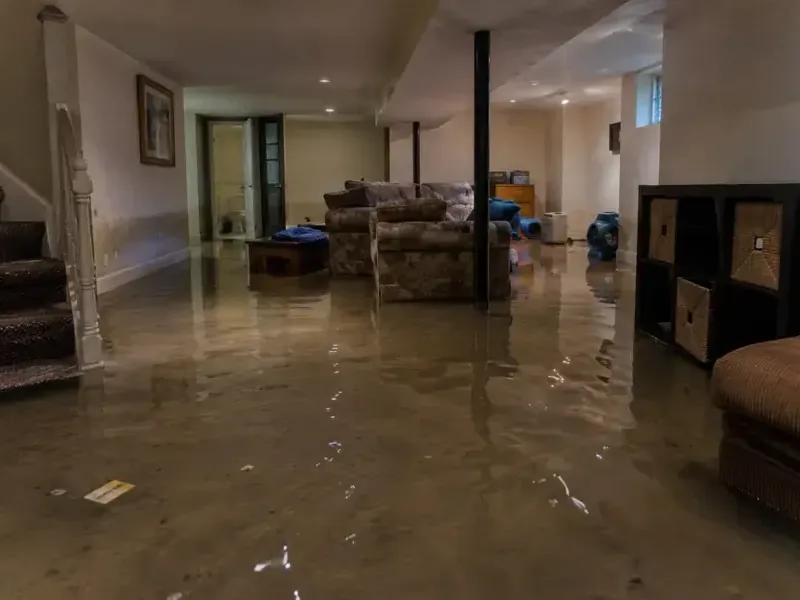
A daylight basement sits partly above the yard, so a hard rain can reach it through a door, a window well or the edge of the floor. In Tucker, where many 1970s and 1980s multi-story homes have one, how fast the water is handled decides how much of the lower level has to come out.
Key takeaways
- Storm water that enters a lower level is treated as contaminated, so wet carpet, pad and low drywall usually come out instead of drying in place.
- Many multi-story homes built in the 1970s and 1980s have a daylight basement, with doors and windows at yard level where rain can get in.
- A sump pump that is unplugged, stalled or overwhelmed lets water rise; check it only when the room is safe to enter.
- Photos, moisture readings and a list of damaged items, started on day one, make an insurance claim easier to document.
- Georgia's flood map site and FEMA's Map Service Center show flood risk by address, before the next storm rather than after it.
How rain reaches a daylight basement
Tucker's housing is primarily 1960s and 1970s ranch and split-level homes, plus 1970s and 1980s multi-story homes that often have daylight basements.
That lower level is partly open to the yard, which gives it light and an outside door. It also gives rain several ways in.
Entry points at yard level
Water usually enters where the basement meets the outdoors. A hard rain finds the lowest and weakest spot first.
- A walk-out door threshold that sits at the same height as a flooded patio.
- A window well that fills faster than it drains.
- The joint where the floor slab meets the foundation wall.
- A downspout that dumps roof water right beside the wall.
What the soil does
Piedmont soils such as the Cecil series carry a red clay subsoil roughly 8 to 42 inches down. Clay drains slowly, so a long rain can leave water sitting against a foundation instead of soaking away.
More than a dozen creeks begin in Tucker, among them Burnt Fork Creek and Henderson Mill Creek, so storm runoff has plenty of low ground to collect in.
The first day: what to do and what to leave alone
Safety comes before cleanup. Water and electricity do not mix, so stay out of a flooded lower level until the power to it is off, and bring in an electrician if outlets or the panel are wet.
Storm water that comes in through a door or wall is not clean water. It carries yard soil and runoff, which is why it is handled as Category 3 water and why surfaces are treated after the water is out.
- Shut off power to the flooded area at the panel only if the panel is dry and easy to reach.
- Photograph the water mark on the walls and every affected item before anything is moved.
- Lift furniture and boxes onto blocks or carry them upstairs.
- Leave wet carpet in place until the crew has taken readings.
- Keep children and pets out of the water, and do not run a household vacuum on standing water.
What the cleanup crew removes, dries and checks
The extraction crew pumps the standing water first. Then comes the removal of what cannot be saved: wet carpet pad, soaked insulation and drywall that wicked water up from the floor.
The full job is described under basement flooding cleanup.
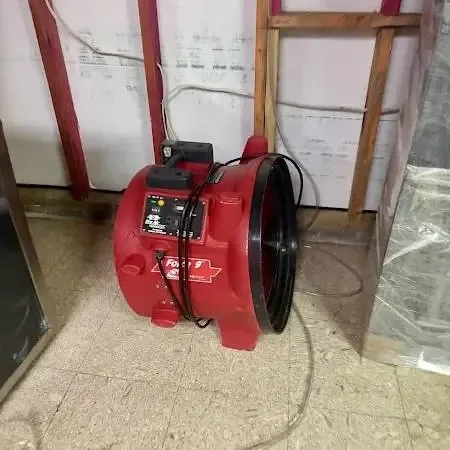
After that, the drying team sets dehumidifiers and air movers and takes moisture readings on the slab, the framing and the lower wall. The equipment stays until the readings come back to a dry reference.
Finished lower levels
A finished daylight basement has more to open up: baseboard, the bottom of the drywall, built-in cabinets and floor coverings. Each one is checked with a meter before it is kept or removed.
- Pad and carpet that sat in storm water usually go.
- Drywall is cut above the wet mark so the wall cavity can dry.
- Hard floors are lifted when water has reached the subfloor or slab edge.
Unfinished lower levels
In an unfinished space the slab and the bottom plates of the walls are the main concern. Stored boxes and wood furniture come out so the floor can dry evenly, and anything that wicked up water is sorted for removal.
The sump pump question
Some lower levels have a sump pit that moves groundwater out. When the pump fails, the room fills from below, often at the same moment a storm is at its worst.
A pump fails for simple reasons: it is unplugged, stalled or overwhelmed by a long rain. A sump pump failure cleanup starts the same way as any other basement job, with extraction, then drying.
- Is the pump plugged into an outlet that has power?
- Does the float move freely, or is it stuck against the side of the pit?
- Is water leaving through the discharge pipe, and is that pipe clear?
- Does the pump run on and on without lowering the water in the pit?
Checking flood risk before the next storm
Georgia's flood map site, georgiadfirm.com, lets an owner type an address and see a flood risk snapshot. FEMA's Map Service Center offers another look at the same question.
A short basement water risk check covers doors, window wells and drainage in a few questions, which helps decide what to fix first.
In September 2009, continuous rain caused 500-year floods across northern Georgia, mostly in and around metro Atlanta, and about 20,000 buildings had major damage. It is a regional record, but it shows how much water a long stretch of rain can bring.
Records, insurance and mistakes to avoid
Homeowners policies often treat sudden water damage and flood damage differently, so the exact wording matters. The crew keeps readings and photos that the insurer can use.
Waiting to see whether a wet basement dries on its own is the costliest mistake. Damp materials can start growing mold within 24 to 48 hours, which turns a drying job into a bigger one.
- Do not tear out everything at once; meter readings show what can stay.
- Do not run a space heater to speed drying, because it can dry the surface and leave the wall wet.
- Do not throw away damaged items before they are photographed.
- Ask the crew to note moisture readings at the start and at the end.
Questions
Is rain water that comes into a basement treated as clean water?
No. Water that enters through a door, a wall or a window well has crossed soil and yard, so it is handled as contaminated, Category 3 water.
Can wet basement carpet be saved?
Sometimes carpet can be lifted and dried, but the pad under it is usually removed, and carpet that sat in storm water is often replaced. The meter readings decide.
How long does a daylight basement take to dry?
It depends on how long the water sat and which materials got wet. The drying team checks the readings during each visit and keeps equipment running until the materials read dry.
What if the sump pump is running but the floor is still wet?
A running pump can still be overwhelmed by a long rain, or its discharge pipe can be blocked. Water on the floor means extraction and drying are needed whatever the pump is doing.
Does a single flooded room mean the whole lower level is damaged?
Not always. Moisture mapping shows where water traveled, and the crew dries and tests the neighboring rooms before deciding what stays.