Structural Drying and Dehumidification in Tucker, GA
Drying a surface is easy; drying framing, subfloor, block and concrete takes air movers, LGR dehumidifiers and daily readings. The drying team keeps equipment running until materials read within 2 to 4 points of a dry reference.
☎ (888) 532-4616Ask what the moisture readings say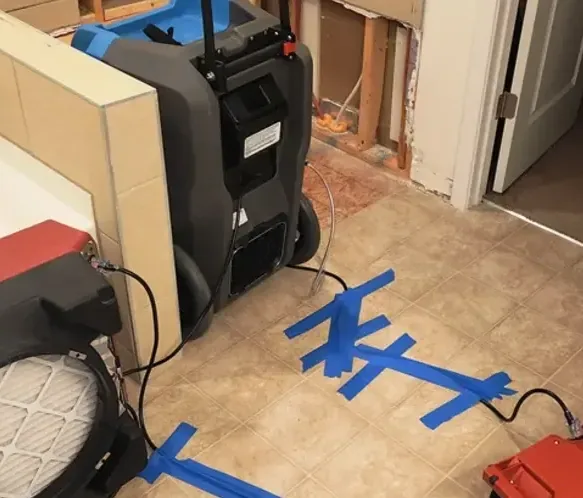
Structural drying is the part of water damage restoration that decides whether a problem comes back. In Tucker lower levels, it often means block foundation walls, a basement slab and the framing above it, materials that hold water long after the carpet feels dry. Humid summer air slows it down further.
How structural drying works
- Moisture mapping of every wet material on day one
- Air movers that sweep air across wet surfaces
- LGR or desiccant dehumidifiers sized to the room
- Daily psychrometric logs: temperature, humidity and grains per pound
Why readings decide, not looks
Drywall can feel dry while the studs behind it are still wet, and a slab can look dry while it is still giving off water. The drying team compares wet materials to a dry reference in the same home and leaves equipment until they match within 2 to 4 points. The EPA indoor air quality pages explain why indoor humidity matters.
Drying block, slab and hardwood
Dense materials release water slowly, so the drying team closes the space, raises the drying rate with dehumidifiers and air movers, and sometimes uses floor drying mats on hardwood. After a flood, Ready.gov covers what to check before moving back into a dried level.
How structural drying and dehumidification is handled, start to dry
Map moisture
Meters and thermal imaging set the baseline.
Set equipment
Air movers and dehumidifiers placed.
Log readings daily
Psychrometric and material readings.
Pull at dry
Equipment out at the dry reference.
First steps for structural drying and dehumidification
Keep the space closed
Doors and windows shut so dehumidifiers work.
Leave equipment running
Do not switch off air movers or dehumidifiers.
Keep the HVAC on
A moderate temperature helps the drying rate.
Stay clear of cords
Keep pets away from equipment and cords.
What does structural drying and dehumidification cost in Tucker, GA?
In Tucker, GA, structural drying typically runs $1,000 to $16,000, depending on how many rooms and levels are wet, the material class, how many equipment days are needed and whether dense materials like block or hardwood are involved.
What moves the number
Ranges are typical, not a quote: the category of water, the square footage, the material class and how fast drying started move the number most. Run the water damage cost calculator for a closer range.
Structural drying and dehumidification across Tucker and nearby DeKalb County
The restoration team covers ZIP 30084 and 30085, from Northlake and LaVista Road out to Mountain Industrial Boulevard, Lake Ivanhoe, Midvale Forest, Browning Chase and the homes off Montreal Road.
Nearby coverage reaches Lilburn, Decatur, Dunwoody, Sandy Springs, Johns Creek, Clarkston, Doraville and Stone Mountain.
See every neighborhood, ZIP and nearby city covered ›Related water damage services
Structural Drying and Dehumidification questions, answered
How long does structural drying take?
Most losses dry in three to seven days. Drywall and carpet dry fastest; hardwood, block walls and slabs take longer. Humid summer weather can add a day or two. Readings decide when equipment leaves.
Why is structural drying equipment so loud?
Air movers push a lot of air across wet surfaces, and dehumidifiers run compressors around the clock. The noise is part of drying fast enough to stay ahead of the 24 to 48 hour growth window.
Can structural drying equipment be turned off at night?
Please leave it on. Turning equipment off lets humidity rise and slows drying, which can add days. If noise is a problem, ask the drying team about placement.
What is a dry reference in structural drying?
It is an unaffected piece of the same material elsewhere in the home. Wet materials are dried until their readings come within 2 to 4 points of that reference.
Does insurance cover structural drying?
When the water loss itself is covered, drying is usually part of the mitigation. Daily logs and photos show the adjuster why each day of equipment was needed. Check your own policy.
Walls still reading wet? Get them dried to the reference.
Framing, block and slab hold water long after surfaces feel dry. The drying team measures it and dries it to the dry reference.
(888) 532-4616Set up the dehumidifiers