When sewage comes up through a floor drain or toilet, the first question is usually whose pipe it is. In Lilburn the answer splits at a spot near the edge of the property, and knowing where that spot is shapes the cleanup and the paperwork.
Key takeaways
- Gwinnett County says a private sewer lateral connects the home to the public sewer, and the property owner maintains it out to the edge of the right-of-way.
- The cleanout at the right-of-way is maintained by the County; a cleanout closer to the house belongs to the private lateral.
- Georgia plumbing code requires a sanitary backwater valve when the lowest fixture is below the next upstream manhole, and the owner maintains that valve.
- Sewer overflows are reported through Gwinnett County, and the cleanup inside the house is a separate job.
- Sewage is Category 3 water: porous materials are removed and surfaces are cleaned and treated, not just dried.
Who maintains which part of the pipe
A sewer backup is easier to sort out once the pipe is split into three parts. Each part has a different owner, and the owner decides who has to act.
The pipe, the valve and the cleanout each carry their own owner, and the location of the blockage decides where the repair begins.
The private lateral
Gwinnett County describes the private sewer lateral as the pipe that connects a home's plumbing to the public sewer. The property owner maintains it out to the edge of the right-of-way, including the connection to the public sewer.
The cleanout at the right-of-way
County standards require a sewer cleanout at the right-of-way, and the County maintains that one. A cleanout closer to the house is part of the private lateral, which is the owner's side of the boundary.
The public sewer
Beyond the right-of-way the pipe is the public system. Storm water that gets into it is called inflow and infiltration, and it uses up pipe capacity that sewage needs.
The backwater valve rule
Georgia plumbing code requires a sanitary backwater valve when the lowest plumbing fixture in a building, such as a basement toilet or sink, sits below the next upstream manhole. The owner maintains the valve.
Gwinnett County also says that if a required backwater valve is missing, the County is not responsible for damage from a sewage backup in the main. That makes it worth knowing whether a valve exists, because it affects who pays for what.
- Ask a plumber whether the lowest fixture in the house is below the next upstream manhole.
- Find out if a backwater valve is installed, and where its access cover sits.
- Keep the valve clear and working; the owner maintains it.
- Keep any inspection records together with insurance papers.
Clues about where the blockage sits
A backup that shows up at only one fixture often points to a blockage in the pipe that serves it. When several fixtures back up together, and the lowest ones in the house go first, the problem may be farther along, in the lateral or the main.
A plumber can confirm where the blockage is. Opening a cleanout is work for a professional, because the pipe behind it holds sewage.
- One toilet or drain only: the blockage is often in that fixture's own branch.
- Several fixtures at once: the lateral or the main becomes a suspect.
- Gurgling in a drain when another fixture empties: air is struggling to move past a blockage.
- Repeated overflows after earlier clearing: the lateral may need an inspection.
What to do in the first stretch after a backup
Stop adding water to the system. Every flush, load of laundry or dishwasher cycle sends more water toward the same blocked spot.
Then keep people and pets out of the affected room, and treat the water as contaminated.
- Do not flush, run the washer, use the dishwasher or let faucets run.
- Stay out of standing sewage and keep children and pets away.
- Photograph the water, the drain and the damaged items before anything is moved.
- Note which fixtures backed up and in what order, because it helps trace the blockage.
- Leave the affected rooms closed so the contamination does not travel through the house.
Reporting a sewer overflow
Lilburn's stormwater page tells residents to contact the Gwinnett County Dispatch Center to report a water service interruption, a sewer service overflow or an illicit discharge. The City Utilities page also links its report-an-outage item to Gwinnett County.
A report to the County is about the public system. It does not clean the floor, the drywall or the carpet inside the house, so the cleanup is arranged separately.
Report the overflow, note the date and time of the report and keep a copy of any reference number. Those details help later if the backup is traced to the public system.
What the cleanup of a sewage backup involves
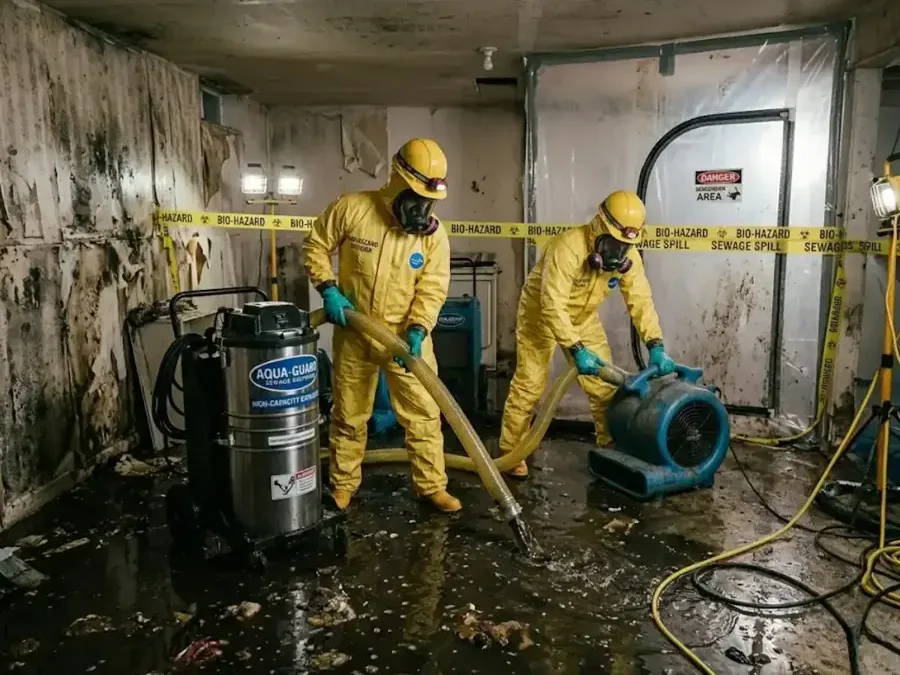
Sewage is Category 3 water, the most contaminated class. The goal is to remove the water and the materials it soaked, not only to dry them.
The steps for sewage backup cleanup in Lilburn follow this order, and the same method is described under sewage backup cleanup.
The extraction crew works in protective gear, pulls the liquid out and then removes porous materials that cannot be made safe again.
- Carpet, pad and soft furnishings that sat in sewage are usually removed.
- Drywall and insulation that wicked contaminated water are cut out above the wet mark.
- Hard surfaces are cleaned and treated with an antimicrobial.
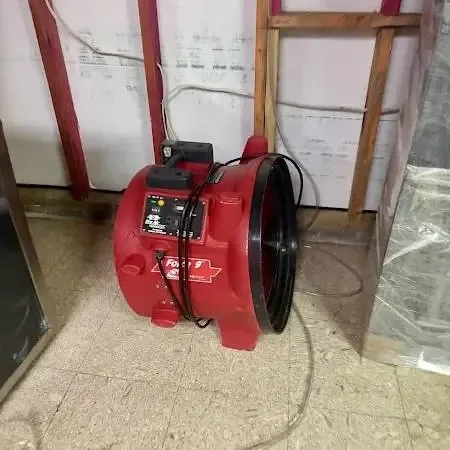
- The structure is then dried with dehumidifiers and air movers, and readings confirm it.
Why records matter
Whether a backup comes from a blockage on the private lateral or from the main can change who is responsible, and the answer is not always clear on the first day. Photos, a short timeline and the crew's readings help sort it out later.
Homeowners policies handle sewer backups in different ways, and some need a separate endorsement. Reading the policy wording and asking the insurer early avoids surprises, and the crew keeps readings and photos for that conversation.
When water has spread to a wider area, water extraction and drying usually follow the removal work. The local response team can be reached through the Lilburn water damage pages.
Questions
Is the sewer lateral the homeowner's responsibility in Lilburn?
Gwinnett County says the property owner maintains the private lateral out to the edge of the right-of-way, including the connection to the public sewer. The County maintains the cleanout at the right-of-way.
What is a backwater valve?
It is a sanitary valve that keeps sewage from flowing back into a building. Georgia plumbing code requires one when the lowest plumbing fixture is below the next upstream manhole.
Who is told about a sewer overflow?
Residents report sewer overflows through Gwinnett County, using the Gwinnett County Dispatch Center named on the city's stormwater page.
Can sewage-soaked carpet be cleaned and kept?
Usually not. Porous materials that sat in Category 3 water are removed, and hard surfaces are cleaned and treated.
Does a storm drain connect to the sewer?
No. Street and parking lot storm drains are not part of the sanitary sewer and do not lead to treatment facilities.