Sewage Backup Cleanup in Dunwoody, GA
Sewage inside a home is a contamination job, not a leak. The crew wears protective gear, extracts the waste water, removes what it touched and sanitizes before any drying equipment goes in.
☎ (888) 532-4616Report the sewage backup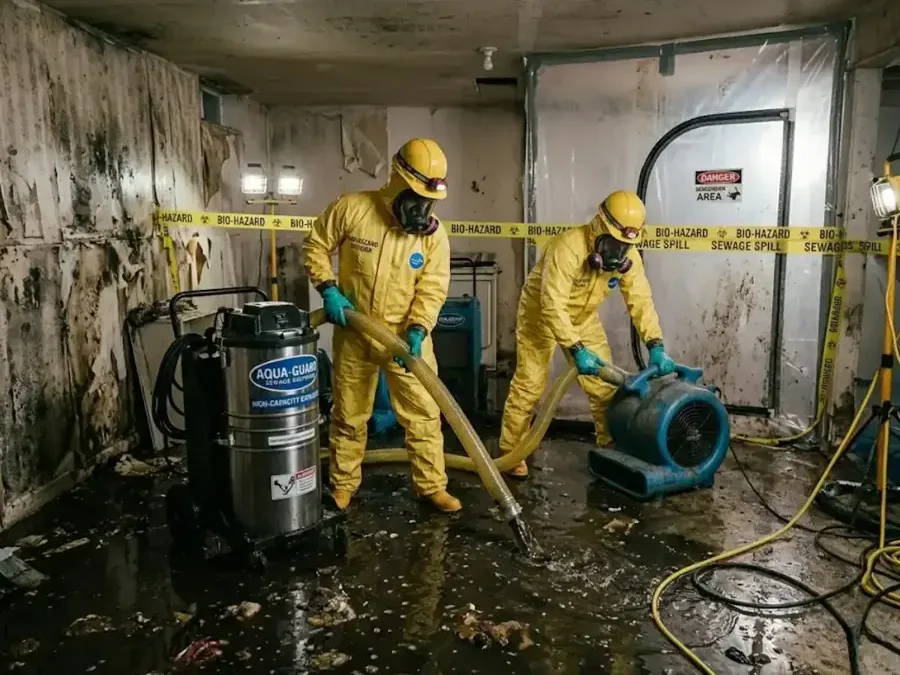
DeKalb County provides sewage service in Dunwoody. Whether a blockage sits in the home's own drain pipe or in the county system, the result inside the house is the same: contaminated water on the floor, and a cleanup that follows stricter rules than a clean leak.
Why sewage is treated differently
Sewage carries bacteria and other contaminants, so carpet, padding, insulation and soft drywall it touched are removed rather than dried. Hard surfaces are cleaned and sanitized. The crew wears protective gear and keeps the work area contained so the contamination does not spread to clean rooms.
What the cleanup includes
- Extraction of contaminated water
- Removal of carpet, padding and soft drywall
- Cleaning and sanitizing of hard surfaces
- Containment and drying once the area is clean
When a storm is behind it
A backup can follow heavy rain, when drains are overwhelmed. A backup that traces to the county system can be reported to DeKalb County, which provides the sewage service, while the inside cleanup falls to a restoration crew. For storm related water, see storm and flash flood cleanup, and for a lower level, basement flooding cleanup.
How sewage backup cleanup is handled, start to dry
Contain
Barriers and gear protect clean areas.
Extract
Contaminated water leaves the home.
Remove and sanitize
Porous items go and hard surfaces are treated.
Dry
Equipment runs to normal readings.
First steps for sewage backup cleanup
Keep out
Everyone stays out of the affected area until protective gear and containment are in place.
Extract
Contaminated water is pumped out and disposed of properly.
Remove and sanitize
Porous materials come out and surfaces are cleaned and treated.
Dry and verify
Equipment runs until the area reads dry and clean.
What does sewage backup cleanup cost in Dunwoody, GA?
A backup in one bathroom or small area typically costs $2,500 to $6,000. A finished lower level runs $6,000 to $14,000, and a deep backup across a whole level can reach $14,000 to $30,000+ because so much material must be removed.
What moves the number
Ranges are typical, not a quote: the category of water, the square footage, the material class and how fast drying started move the number most. Run the water damage cost calculator for a closer range.
Sewage backup cleanup across Dunwoody and nearby communities
Sewage backup cleanup covers Dunwoody, from the streets near Peachtree Industrial Boulevard and Winters Chapel to Georgetown, Tilly Mill, Perimeter Center and the neighborhoods around Brook Run.
The same service nearby: sewage backup cleanup in Tucker, Sandy Springs, Johns Creek.
Water damage restoration in Dunwoody › Every town covered ›Related water damage services in Dunwoody
Sewage Backup Cleanup questions, answered
Is it safe to clean up sewage without help?
Sewage carries bacteria and other contaminants, so protective gear and proper disposal matter. Keep children and pets away and avoid touching the water. Even small backups should be treated as hazardous.
Why can't soaked carpet be saved?
Porous materials absorb the contamination and cannot be fully sanitized, so carpet, padding and soft drywall that sewage reached are usually removed.
Who handles a backup caused by the county system?
DeKalb County provides sewage service here, so a backup that traces to the system can be reported to the county. The restoration crew cleans the inside of the house either way.
Does insurance cover a sewage backup?
Often only with a water backup endorsement, so check the policy before assuming. Photos, drying logs and the cleanup record support the claim.
When is the area safe again?
After contaminated materials are out, surfaces are sanitized and meters read dry. Only then should rebuilding start.
Backup inside the house? Get it cleaned and sanitized.
Call any hour and say which rooms are affected and how far the water spread. That tells the crew which protective gear to bring.
(888) 532-4616Start the sanitizing