Structural Drying and Dehumidification in Sandy Springs, GA
After a leak or flood, walls, framing and floors hold water that cannot be seen, so the drying team in Sandy Springs uses air movers, dehumidifiers and meters to dry the structure to normal readings.
☎ (888) 532-4616Ask about drying equipment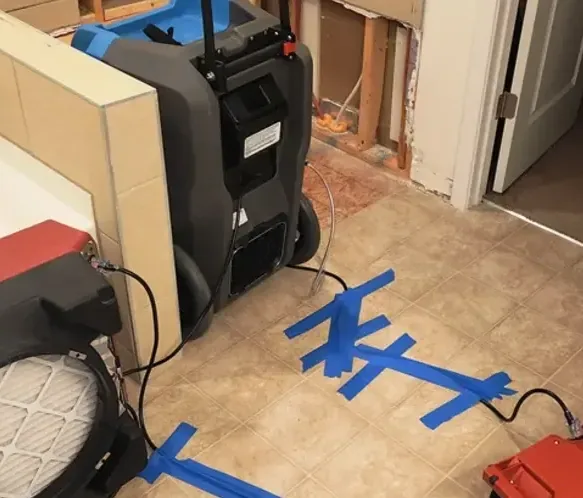
Water that is no longer visible can still be inside the wall. Drywall, framing, subfloors and insulation absorb moisture and release it slowly, which is why a room can feel dry while the structure is not. Structural drying removes that hidden water on purpose, with equipment and measurements instead of guesses.
How the equipment works
- Air movers sweep moisture off wet surfaces
- Dehumidifiers pull it out of the air
- Meters track the wettest materials
- Containment keeps the humid air in one zone
Humid climate, careful drying
Sandy Springs has a humid subtropical climate, so outdoor air does not always help dry a wet room and the equipment has to do the work indoors. The same equipment serves a burst pipe or a flood. Doors and windows are usually kept closed, and the dehumidifiers are sized to the volume of the wet space and the amount of moisture the materials hold.
When the equipment can come out
Readings are taken at the start and on each visit, and the numbers are compared with dry reference points from unaffected materials in the same building. Equipment is moved or adjusted as areas dry, and it stays until every wet material reaches its target. Removing it too soon leaves moisture behind that can damage finishes later, so the log of readings is the proof the job is done. Standing water has to be removed first through water extraction.
How structural drying and dehumidification is handled, start to dry
Measure
Meters record moisture in every wet material.
Set equipment
Air movers and dehumidifiers go in place.
Monitor
Readings are logged at each visit.
Release
Equipment leaves when targets are met.
First steps for structural drying and dehumidification
Close the area
Keep doors and windows shut during drying.
Leave equipment on
Air movers and dehumidifiers should run all day and night.
Do not move units
Positions are set from meter readings.
Report any odor
A musty smell during drying should be mentioned to the crew.
What does structural drying and dehumidification cost in Sandy Springs, GA?
Structural drying generally runs $1,000 to $3,000 for one room, $3,000 to $8,000 for a full lower level, and $8,000 to $16,000 or more for several levels or dense materials.
What moves the number
Ranges are typical, not a quote: the category of water, the square footage, the material class and how fast drying started move the number most. Run the water damage cost calculator for a closer range.
Structural drying and dehumidification across Sandy Springs and nearby communities
The drying team sets equipment in houses, apartments and offices across the city, from Riverside and the North End to City Springs, the Dunwoody Panhandle and Perimeter Center.
The same service nearby: structural drying and dehumidification in Tucker, Dunwoody, Johns Creek.
Water damage restoration in Sandy Springs › Every town covered ›Related water damage services in Sandy Springs
Structural Drying and Dehumidification questions, answered
How long does structural drying take?
Most jobs need three to five days, though thick framing, hardwood and heavily soaked materials can take longer, and the readings decide when drying is finished.
Why are fans and dehumidifiers both needed?
Air movers push moisture off the surface into the air, and dehumidifiers pull it out of that air so it cannot settle on other materials; one without the other dries slowly or unevenly.
Can wet drywall be dried in place?
Sometimes. Clean-water drywall caught early can be dried with the surface intact, but sagging, swollen or contaminated drywall is cut out so the framing behind it can be reached.
What does a moisture reading actually show?
A meter reports how much moisture a material holds compared with a dry reference, which shows whether a wall that looks dry is still wet inside and whether drying is working.
Why does drying need to start early?
Damp materials can begin to support mold after a day or two, so early drying shortens the time they stay wet and limits how much has to be removed.
Hidden moisture damages framing and finishes long after the water is gone.
The drying team places air movers and dehumidifiers and checks readings at every visit until the structure meets its dry targets.
(888) 532-4616Sandy Springs structural drying help